
ANISEED MYRTLE: Sweet-leaf tonic
Aniseed Myrtle (also known as Anise Myrtle and Ringwood) has been known and used by First Nations Peoples in the Northern NSW rainforests for thousands of years, mostly medicinally. It was used for digestive issues, menstrual cramps, hiccuping; as an immune system support for cough and colds; as a revitalizing tonic and, the wavy leaves were used in smoking ceremonies.
Today Aniseed Myrtle is used in culinary concoction such as baked goods, seasoning for savoury dishes, ice cream, cocktails and teas. Aromatherapy, bath soaks and perfumes.
Grow Aniseed Myrtle
Common name: Anise or Aniseed Myrtle, Ringwood
Scientific name: Syzygium anisatum, Backhousia anisata, current Anetholea anisata
Family: Myrtaceae
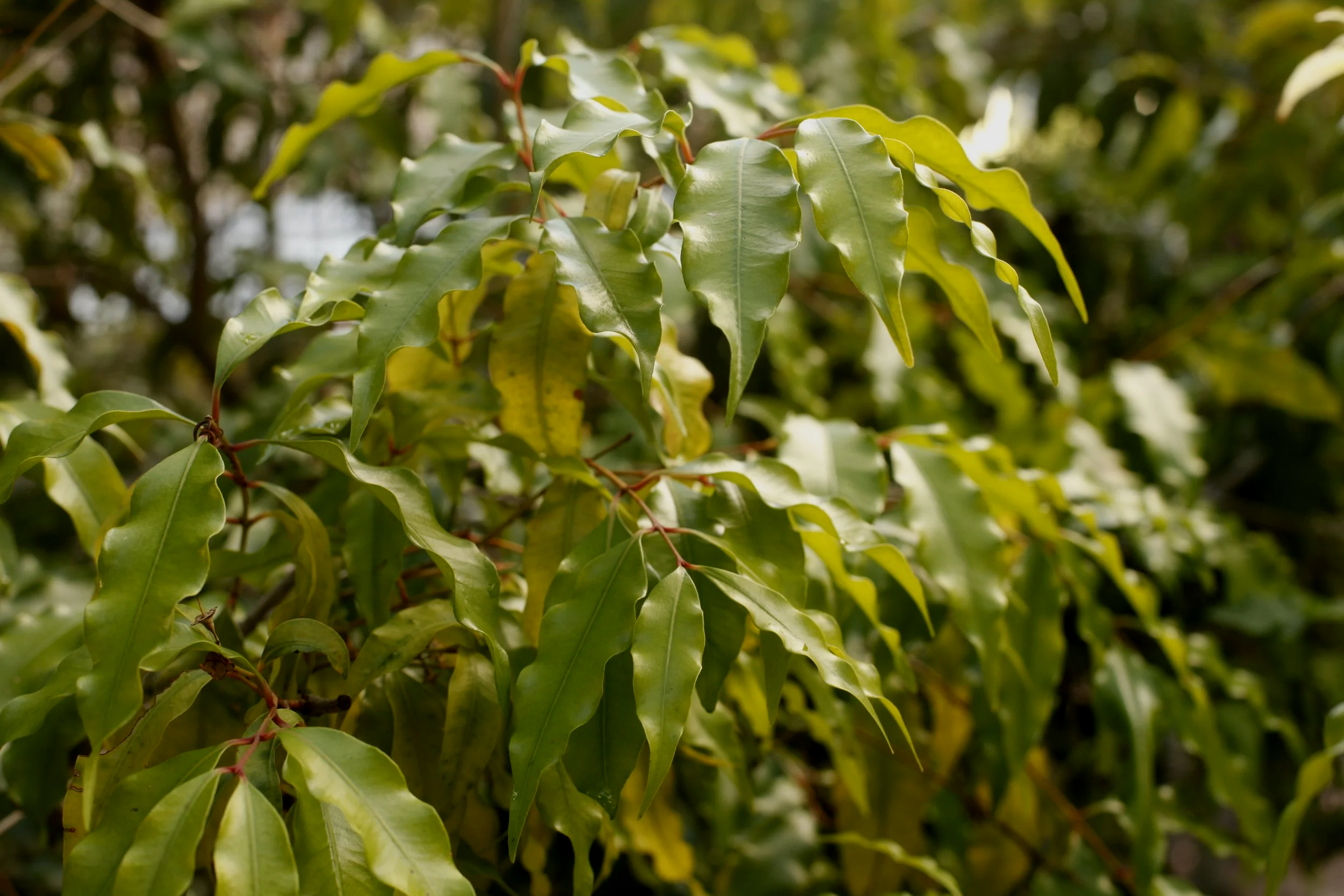
Description: A medium to large tree in the wild growing up to 45m, in cultivation it grows to 10m and 4m width. Its young leaves are soft pink and become dark, glossy and wavy along the edges as they mature. The mature leaves are opposite and lanceolate, emitting a strong aniseed aroma when crushed.
Creamy white flowers are produced in panicle-like clusters in the warmer months from October-November. The fruit (schizocarp) is then matured and splits open to release the seed within.
Distribution: Although only rarely found in the wild, this rainforest plant grows in Eucalyptus forests along streams of the North East Coast NSW and South Coast QLD.
This sweet-leaved tree is easy to grow and has an attractive canopy that would be a great choice for any sensory or tea garden, rainforest or bush tucker garden.
Due to its dense leaf growth, it can be planted for privacy and screening. While it is slow to mature, it is long lived and hardy in the garden. It is a low maintenance tree in the right environment once established.
The dense undergrowth story habitat creates a shelter for small birds and microhabitats for frogs and insects. It stabilizes soil and erosion especially along valley streams and lower slopes. Not prone to bushfire, can regenerate from seed bank after fire as well as branch shoots and suckering stems/trunks.
Tea profile
Taste: sweet, aromatic, pungent, warming, fennel/liquorice
Brewing:
Due to its strong flavour, only ½ tsp dried aniseed myrtle per cup of boiling water is recommended. Let to steep for 2-3 min then strain. This will result in a sweet liquorice flavoured tea.
For longer infusions, add 1 tsp to a cup of boiling water and allow to simmer for 10-15min. This infusion will be more astringent and concetrated.
For a cold infusion add 2 tsp per cup of room temperature water and allow to steep in the fridge for 4 hours or overnight, shaking occasionally.
Blending:
For fresh tea blends Aniseed Myrtle can be blended with sour flavours such as rosella or other berries.
Blend with minty plants such as rivermint for cold infusions in summer.
For warming spiced tea blend, Aniseed Myrtle works well with pungent herbs such as rosemary, tulsi, fennel or valerian root.
Fresh vs dry herb: Typically you will need less dried herb for teas. A rough estimate is 1.5-2x fresh to 1x dry (e.g. 1 tsp dry to 1.5 tsp fresh herb).
Health Uses
Primary actions: carminative, antispasmodic, antibacterial, antioxidant, anti-fungal, anti-microbial, galactogogue, nervine, expectorant
Uses- intestinal cramps, bloating, flatulance, cough and colds, colic, breast milk production, used by First Nations peoples as a revitalising tonic, relaxation
Energetics: warming, relaxing, moistening but also drying
Its carminative properties and it’s anethole content act as to soothe the digestive and respiratory systems.
With is high antioxidant content, Aniseed Myrtle can protect against oxidative stress and help to reduce risk of chronic diseases as well as supporting healthy aging.
Anethole, the primary constituent of Aniseed Myrtle, has been found to have antidepressant and anxiolytic effects both through mediating oxidative stress and by interacting with the neurotransmitters that act on the central nervous system- which plays a role in mood and anxiety.
Pharmacological information
Primary constituents: Trans-anethole
Phytoconstituents: superior antioxidant profile, and is high in vitamin C, E, folate, lutein, zinc, calcium and magnesium, as well as chlorophyll a and b.
-
Please check with your health practitioner before making any changes to your diet or taking supplements or herbs, especially if you are pregnant, breast feeding or have a health condition that requires the use of benzodiazepines or opiates. Always read instructions for use carefully.
-
Tucker Bush. (2017, November 10). Aniseed Myrtle - Syzygium anisatum - Tucker Bush. https://tuckerbush.com.au/aniseed-myrtle-syzygium-anisatum/
Cáceres-Vélez, P. R., Ali, A., Fournier-Level, A., Dunshea, F. R., & Jusuf, P. R. (2024). Phytochemical Composition and Toxicological Screening of Anise Myrtle and Lemon Myrtle Using Zebrafish Larvae. Antioxidants (Basel, Switzerland), 13(8), 977. https://doi.org/10.3390/antiox13080977
Guerrero, C., & Guerrero, C. (2024, October 28). Aniseed Myrtle: a versatile gem of Australia’s flora. Muru Mittigar. https://www.murumittigar.com.au/aniseed-myrtle-a-versatile-gem-of-australias-flora/
Khodadadian, R., & Balali-Dehkordi, S. (2024). A comprehensive review of the neurological effects of anethole. IBRO neuroscience reports, 18, 50–56. https://doi.org/10.1016/j.ibneur.2024.12.012
Australian Plants Society. (2024, August 14). Anetholea anisata | Australian Plants Society. Australian Plants Society | Resources. https://resources.austplants.com.au/plant/anetholea-anisata/
PlantNET - FloraOnline. (n.d.). https://plantnet.rbgsyd.nsw.gov.au/cgi-bin/NSWfl.pl?page=nswfl&lvl=sp&name=Anetholea~anisata
Sultanbawa, Y. (2016). Anise Myrtle (Syzygium anisatum) Oils. In Essential Oils in Food Preservation, Flavor and Safety (pp. 215–219). Academic Press. https://www.sciencedirect.com/science/chapter/edited-volume/abs/pii/B9780124166417000237?via%3Dihub
-
The information on this page is educational only and is not intended to diagnose, treat, cure, or prevent any disease.
Information on this website is not intended to replace the support and care of a mental health clinician. Seek the support of a trusted friend, counsellor or psychologist because you deserve support and to care for yourself.